

IBM, Fermilab and NVIDIA announced today plans to build a new quantum computing platform that combines their expertise to advance how quantum and classical computers can work together. The collaboration marks an effort to create the modular, interconnected architectures that researchers say will be necessary for quantum computing to solve real-world scientific problems beyond the reach of traditional supercomputers alone.
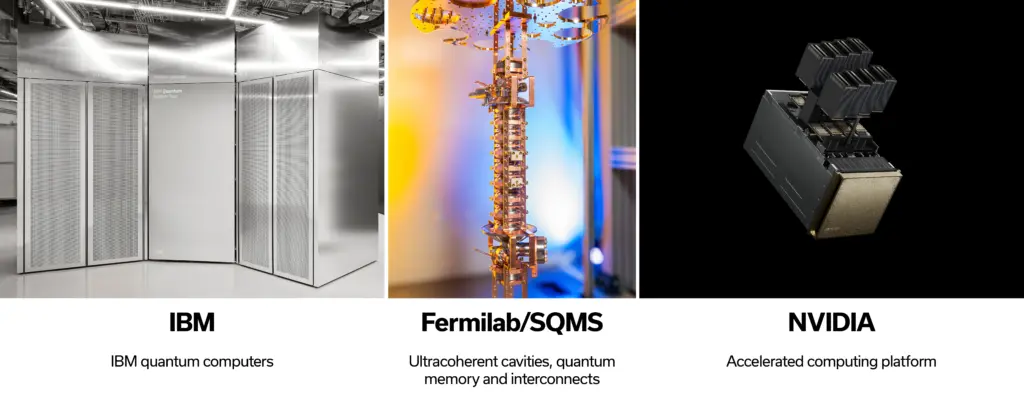
The three organizations plan to co-locate NVIDIA DGX B200 systems with IBM quantum computers, including IBM’s Quantum Nighthawk processor, which the company describes as its most powerful quantum system to date. Nighthawk operates 120 qubits and can run circuits of up to 7,500 two-qubit operations at speeds reaching 100,000 samples per second.
The platform will leverage Fermilab’s Superconducting Quantum Materials and Systems Center to explore how multiple quantum processors can work together and scale classical computing alongside them. Researchers plan to use it to tackle computationally demanding problems in high-energy and nuclear physics, including lattice gauge theories, neutrino interactions and nuclear simulations.
“Some of the most fundamental problems in science remain out of reach for classical computers alone,” said Jerry Chow, IBM Fellow and Chief Technology Officer of Quantum-Centric Computing. “Scaling quantum and classical together will open new frontiers in high-energy and nuclear physics and beyond. With Fermilab and NVIDIA, we plan to explore how these real-world problems can help us shape the modular, interconnected architectures that will define the next generation of quantum computers and accelerated classical computing.”
The collaboration also includes a technical advancement that addresses a longstanding challenge: how to integrate quantum processors into existing supercomputing environments. IBM and NVIDIA, working with quantum company Pasqal, have developed a Quantum Resource Management Interface that integrates quantum computers directly into Slurm, the scheduler that manages most of the world’s largest supercomputers.
Previously, quantum processors had to be attached to Slurm through external plugins. The new integration allows researchers to treat quantum-classical workflows as normal supercomputing jobs, eliminating the need for separate queues or login processes. The approach is vendor-agnostic, meaning it can support quantum processors from different manufacturers.
Krysta Svore, vice president of applied research for quantum computing at NVIDIA, said: “Realizing quantum computing’s potential requires quantum processors and accelerated computing to evolve together as accelerated quantum supercomputers. IBM, Fermilab, and NVIDIA are working together to give researchers the tools they need to make scientific discoveries with quantum computing.”
New research from IBM, RIKEN and NVIDIA demonstrates the potential of hybrid quantum-classical computing. The team studied an iron-sulfur cluster, a molecular structure found in living cells, using quantum computers combined with NVIDIA GPUs. By running circuits of up to 4,000 two-qubit operations on 72 qubits and collecting 5 million samples, researchers achieved a 79-fold improvement in accuracy over previous attempts at the same calculation.
The results approached the accuracy of DMRG, a leading classical simulation method known for its high precision, suggesting that quantum-classical hybrid approaches may soon tackle problems that remain extremely demanding for classical methods alone.
“This marks an important step toward applying quantum-HPC hybrid computing to scientific problems,” said Seiji Yunoki, team principal at RIKEN’s Computational Materials Science Research Team.
Anna Grassellino, Fermilab’s chief technology officer, called the collaboration “an important step toward the capabilities and community needed for a future DOE quantum computing user facility.”