

Detroit-based Swarm Defense Technologies has been chosen as one of 25 companies to participate in the U.S. Department of War’s Drone Dominance Program, a $1.1 billion initiative aiming to deploy attack drone systems across military branches at an unprecedented scale.
The selection marks a major milestone for the company, which will now compete in the program’s first testing stage known as the Phase I Gauntlet. Later this month, military evaluators will test participants’ systems across several mission profiles, including 10-kilometer strike operations and urban target identification. Only up to 12 companies will move forward to early production contracts, with the full program projected to deliver around 340,000 drones by January 2028.
Company founder and CEO Kyle Dorosz said Swarm Defense plans to showcase both its manufacturing capacity and software expertise. “We’ve been manufacturing drones in Detroit for eight years—over 20,000 units for entertainment uses—and now we’re applying that same know-how to defense,” he said.
Swarm Defense spun off from Firefly Drone Shows in 2024 to focus on defense applications. The company currently operates a Metro Detroit production facility with a fully NDAA-compliant supply chain capable of producing 72,000 drones per year, a number it plans to expand to over 250,000. Dorosz described the program as a way to build U.S. manufacturing strength in an industry largely dominated by Chinese producers.
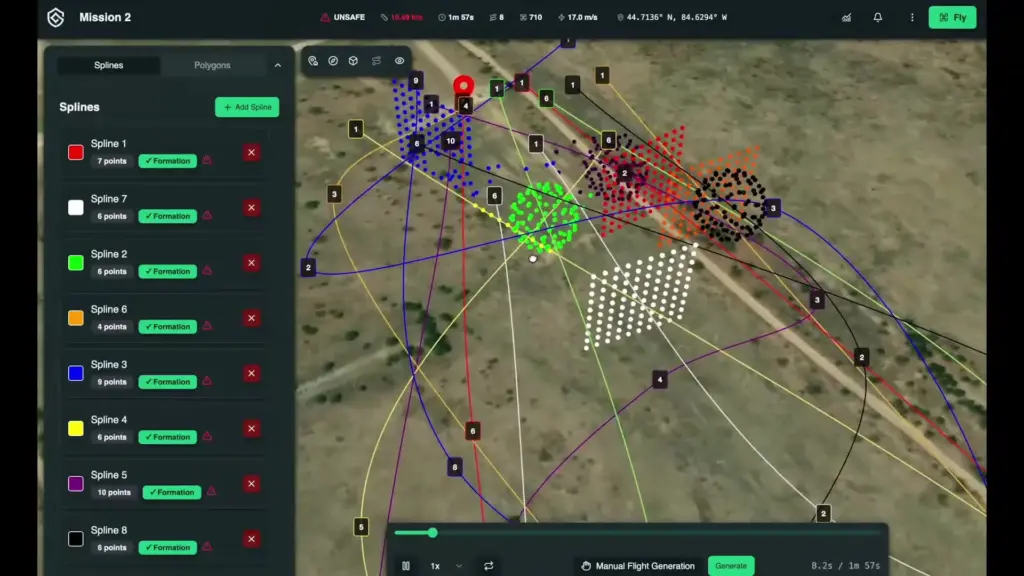
At the heart of Swarm Defense’s pitch is its proprietary swarm coordination software. The system allows a single operator to manage thousands of drones simultaneously using real-time path deconfliction algorithms that prevent mid-air collisions. According to company president and former Navy SEAL Adam Wright, this technology will become crucial in later phases of the program when operators must control multiple drones at once. “Our algorithm enables large-scale coordination,” Wright said. “One person can deploy a massive swarm in minutes.”
Wright also pointed to lessons drawn from modern conflicts such as Ukraine, where low-cost drones have played an outsized role. “When an inexpensive drone can destroy a multimillion-dollar target, the strategic balance shifts,” he said. “Future conflicts will require large numbers of reliable, affordable systems rather than small fleets of high-end platforms.”
Swarm Defense’s current flagship product, the KIWI one-way attack drone, has a modular payload design, a range exceeding 10 kilometers, and a stackable form factor aimed at fast field deployment. Those design priorities emerged from the company’s roots in entertainment drones, where quick setup and reliability are essential.
The company’s portfolio now spans training target systems, swarm coordination software, and one-way attack platforms. All of its systems are built in the United States with secure, NDAA-compliant supply chains. Swarm Defense says it is also prepared to work with allied governments seeking interoperable drone solutions built in the U.S.