

Dictionary.com has rolled out its 2026 Winter Word Drop, adding more than 1,500 new entries that highlight how English continues to absorb scientific advances, online trends and influences from around the world. The company notes that science and technology terms make up the largest share of the update, accounting for 26 percent of additions, while dozens of new borrowings from other languages reflect expanding global connections.
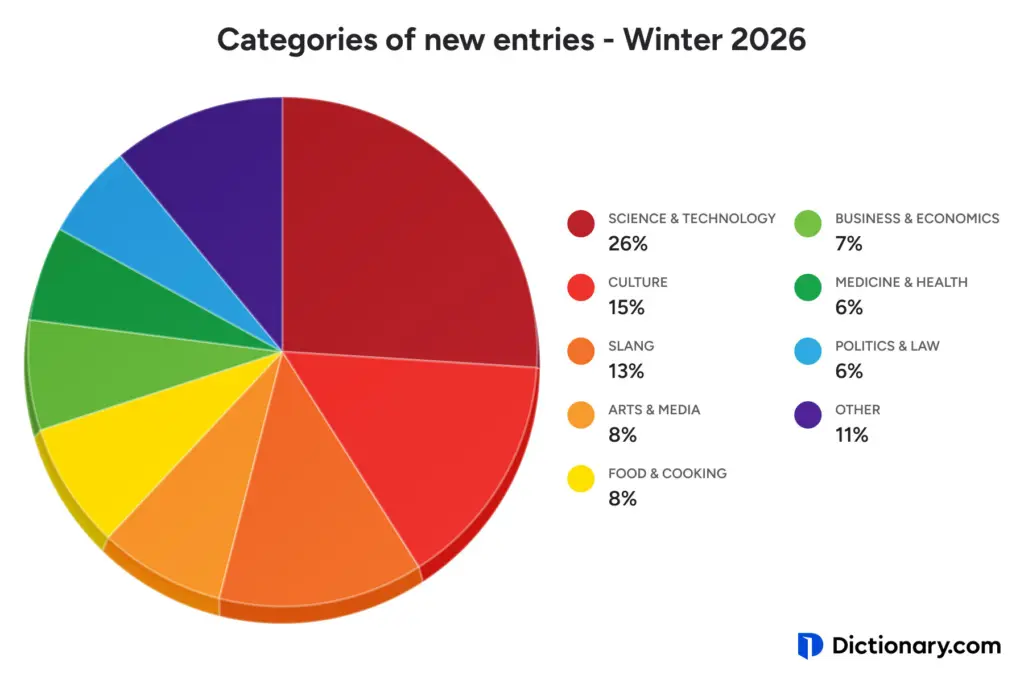
The update includes 55 direct borrowings from other languages, 40 percent of which come from Japanese, a detail Dictionary.com links to rising international travel and cultural exchange. Taken together, the new entries are presented as capturing English at a particular moment in time, with speakers looking outward for cultural influences, inward at trends that shape digital identity and toward ongoing scientific innovation.
“English has historically expanded during periods of significant scientific and cultural change,” said Steve Johnson, PhD, Director of Lexicography for the Dictionary Media Group at IXL Learning. “This update illustrates how AI innovation, conversations about health, international travel and digital communities are shaping our language in real time.”
On the science and technology front, the Winter Word Drop brings several artificial intelligence terms into the dictionary. New entries include “prompt engineering,” defined as the process of designing appropriate and effective inputs for a machine learning algorithm; “large language model,” or LLM, described as a type of machine learning software model trained on extremely large sets of language data and designed to generate naturalistic responses to prompts; and “auto-generated,” referring to content produced or created by a computer program.
Biomedical and environmental vocabulary is also more visible in everyday discourse and now in the dictionary. The update adds “health span,” defined as the typical period of a person’s life during which they are consistently in good health; “nanoplastic,” a tiny plastic particle, especially one 1,000 nanometers or less, formed from the breakdown of other plastics; and “biohacker,” a person who biohacks or seeks self-improvement through strategic experimentation with technology, drugs, hormones, diet and similar interventions.
Online language and internet culture remain a major engine of change. Terms that started in niche communities have become widespread enough to warrant entries. New additions include “copium,” a metaphorical substance used to suggest someone is engaging in self-delusion to cope with loss or a difficult realization; “glamazon,” describing a woman who is beautiful and glamorous as well as tall, strong or powerful; and “side quest,” a quest or objective in a story or video game that is related to but not part of the main storyline. The update also adds “black pill,” defined as something that makes a person believe there is no hope for resolving a major problem or changing society for the better, and “white pill,” something that makes someone hopeful about their personal future or about improving society.
New food and drink terms underscore how global cuisines have entered everyday English usage. Among them are “furikake,” a seasoning mixture that typically includes dried seaweed, sesame seeds, salt and other ingredients and is sprinkled over rice, vegetables or other foods; “karaage,” a Japanese cooking technique in which pieces of chicken, other meats, fish or seafood are marinated and then coated in flour and potato starch before deep frying; and “jjigae,” a traditional Korean stew. The dictionary also adds “pasta al forno,” an oven-baked Italian pasta dish, and “smashburger,” a hamburger made with a patty pressed very thin onto a hot griddle or cooking surface.
Dictionary.com frames the Winter Word Drop as evidence that language is moving with people as they move online and around the globe. The company positions itself as keeping pace with those shifts, presenting its site as a way to observe how people talk, connect and make sense of the world. Dictionary.com describes itself as the internet’s leading language reference and learning destination, serving millions of users who turn to it daily for definitions, grammar guidance and editorial content that help them understand and use words more effectively.
The 2026 Winter Word Drop is presented as one more snapshot of English adapting to changing technology, culture and global interaction.